
Imagine a public authority deciding where to build a new service centre. A system compares population, distances and recorded demand, then recommends a location. This option receives the highest score. One neighbourhood remains far from the service and asks why. The official reply lists variables, describes their weights and adds a graph. Everything is comprehensible. What remains unexplained is why counting previous visits was a fair way to measure needs in a place where reaching the service was already difficult.
This is a hypothetical example, but the distinction it illustrates has practical consequences. Explaining a calculation reveals what the system did. Justifying a decision requires defending the relevance of its criteria, the facts used and the authority to impose the result. The administration may have calculated a correct answer to a poorly chosen question. Improving the explanation of the calculation does not change that question; it makes more visible the decision somebody must defend.
One central idea in Rodrigo Castillo's work on algorithmic public reason is that a system's outputs acquire authority within human practices and institutions. A machine need not think, desire or stand for election for its recommendation to influence what the state decides. An office merely has to adopt the output as a premise and stop discussing it. The political problem begins in that transition, when a capacity to produce information becomes a reason to demand obedience from someone else.
An authority using AI needs to be able to explain its conduct and allow what it explains to remain open to challenge. A right to obtain information helps, but democracy also requires objections to be able to reach the criteria behind decisions. Access to the answer is a beginning. Being treated as someone to whom a reason is owed changes the entire relationship between the institution and its public.
A prediction does not choose the objective
The service-centre example contains at least two questions. One seeks to predict where there will be most visits. Another asks whose access ought to improve. They may point in the same direction, but not invariably. A neighbourhood facing transport difficulties may register little demand precisely because its residents cannot get there. Treating that record as evidence of limited need preserves a disadvantage while appearing to follow the data. The inference needs examination before a score becomes a location.
It would not be enough simply to order the model always to favour the least-served neighbourhood. Other needs, budget constraints and differences in severity may deserve consideration. The choice has to be visible: what importance each objective received, what sacrifices follow and why they can be defended to those bearing them. Technical analysis can help estimate the consequences of different criteria. Choosing between them requires reasons concerning the service to be provided and the institution's obligations to its users.
Presenting the highest-scoring option as the only rational answer removes part of that choice from public language. A dissenter appears to be arguing with mathematics, even when the objection concerns the objective mathematics was instructed to optimise. Precision then acquires a second, less innocent function: it makes it harder to recognise where a political decision remains. A graph can be impeccable while giving an incomplete picture of the disagreement. Better data will not settle a dispute about which outcome the data should help pursue.
Reasons addressed to the recipient
Public reason concerns how power can be justified to people who hold different convictions while remaining equal members of a political community. It does not require everyone to share every conclusion, or mean that a decision becomes invalid whenever somebody protests. It requires authorities to offer relevant, examinable grounds consistent with the standing of those subject to them. Disagreement does not turn a citizen into a fault in the administrative process.
In his manuscript, Castillo proposes the Test de Razón Pública Algorítmica, or TRAP, to examine the incorporation of systems into high-impact decisions. Its principle of algorithmic non-closure requires a substantive forum in which authorities provide reasons that affected people can evaluate. The test is the author's normative proposal, not a legal certificate or an official standard. Its value lies in asking which practices sustain justification, beyond checking that a box marked “oversight” has been ticked.
The manuscript itself warns that meeting indicators is insufficient to establish legitimacy. An institution might learn to present explanations, records and appeal channels that influence nothing. The test is therefore best read as a demand for institutional practice: showing how an objection is examined and what can change if it proves well founded. A procedure that merely prints the previous decision again preserves the printer, but not necessarily public reason.
Understanding has an object
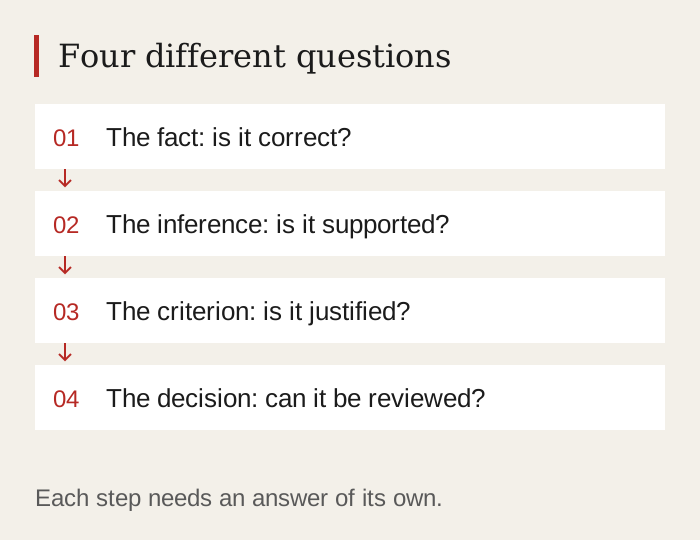
Different questions require different explanations. A person arguing that their income was recorded incorrectly needs to locate and correct the data. Someone disputing that living with a relative implies receiving practical support is challenging an inference. Someone objecting that a particular fact should not determine access to a benefit is questioning a criterion. Giving all three the same document describing the model's architecture may look transparent while being of little use to any of them.
An adequate explanation connects information to what the recipient needs to examine. It may identify which data were involved, where they came from, what result their combination produced and how that result entered the decision. It should also distinguish what the authority chose from what the system estimated. If an institution set a threshold, it should not hide that choice behind a probability. A machine may have calculated the number; deciding what follows from it remains a separate, identifiable operation.
This requires fidelity. A persuasive text written afterwards may describe a possible justification without revealing what actually supported the decision. The explanation must correspond to the case file and preserve evidence enabling that correspondence to be checked. Asking another AI to draft an elegant response does not, by itself, establish the connection. Friendlier prose can improve treatment, but it can also cover a refusal nobody has reconsidered.
Europe: explaining so that people can challenge
In Dun & Bradstreet Austria, C-203/22, on 27 February 2025, the Court of Justice of the European Union held that information about automated assessment must enable the person to understand and challenge the decision. Supplying the algorithm alone was insufficient. Where trade secrets or third-party data were invoked, a competent authority or court had to balance interests, rather than accept a general exclusion of access. Source: Court of Justice of the European Union
The institutional lesson extends beyond a preference for simple explanations. Possessing code does not guarantee the ability to reconstruct an inference; receiving a formula does not necessarily reveal which personal information mattered. Conversely, protecting legitimately confidential information need not leave the assessment beyond scrutiny. Access has to be distributed: a person may need an explanation of their case while an independent body needs technical material that would be inappropriate to publish in full.
Article 22 of the EU's GDPR addresses decisions based solely on automated processing with legal or similarly significant effects, and provides for exceptions and safeguards. Article 15 includes access to meaningful information about the logic in the relevant circumstances. These conditions matter: they do not describe an unlimited right to demand an explanation of every calculation involving software. Source: European Union
The democratic question is wider than that precise legal situation. A system may determine which files a person receives first and substantially shape the eventual decision even though a human signs it. Investigating that influence means looking at the whole procedure. It would be wrong to pronounce every assisted use automatically prohibited; equally, the presence of a signature cannot be a sufficient answer to every question about how an institution reached its conclusion. A formal description of the last step may obscure the choices made earlier.
Chile is not starting from nothing
Chile's Law 19.880 already requires facts and legal grounds to be stated in acts affecting rights and decisions on administrative appeals. Article 41 requires a reasoned decision and information about available challenges. These are obligations of administrative procedure; using AI does not replace the need to connect an act with its evidence and legal basis. Source: Biblioteca del Congreso Nacional de Chile
The personal-data reform in Law 21.719 introduces Article 8 bis on automated decisions with legal or significant effects, including exceptions and safeguards for explanation, human intervention and review. General application of these amendments begins on 1 December 2026: on 25 September, that approaching regime must still be distinguished from obligations already enforceable. Source: Biblioteca del Congreso Nacional de Chile
Keeping those dates separate prevents two practical mistakes. An institution should not claim a future guarantee is already operating merely because legislation has been enacted. Nor should it assume that, while waiting, its decisions carry no duties to provide reasons. Specific new rights may clarify routes and extend protection; preparing for them requires examining how data are preserved, which office receives requests and what information it will be able to supply. The commencement date will not build those capabilities on its own.
For Chile, comparison is useful when it identifies what each instrument does. Data legislation protects individuals within its scope; administrative procedure organises relations with an authority; system-level supervision can examine recurring practices. These instruments are not interchangeable. Copying an explanation requirement without securing access to evidence can produce empty replies. Creating a specialist office without connecting its work to individual files may reveal a problem after the opportunity to correct it has passed. The relationship among institutions matters as much as their individual mandates.
Canada: preparing the explanation before deciding
Canada's Directive on Automated Decision-Making applies to federal institutions subject to the relevant policy, not to every use of AI in Canada. It requires impact assessment and graded requirements, including meaningful explanations. For proprietary software it establishes institutional rights of access, testing and monitoring under safeguards. It is an administrative directive with a defined scope, not a universal law of explainability. Source: Treasury Board of Canada Secretariat
The comparison is revealing because of when the question is asked. An administration expecting to explain a decision must first negotiate the access that will make explanation possible. Waiting for the first complaint leaves the response dependent on a contract that may say nothing useful. The institution needs to identify what to preserve, who can examine it and how information will be supplied without disclosing other people's data. Explanation begins in the design of the supplier relationship, even though citizens see it only at the end.
This does not mean every public body must build its own models. Purchasing external knowledge can expand capacity. But the purchase should include the conditions needed to meet public obligations. A cheap service that prevents investigation of its operation may transfer costs to a future case file. The authority then discovers that it bought a technical solution while leaving the means of justifying its use off the invoice.
Publishing code does not settle the disagreement
Technical openness can be valuable. It allows specialists to examine rules, identify mistakes and test claims. Its effect depends on what is published and the resources available to use it: an incomplete repository, lacking relevant data or version documentation, may reveal less than its size suggests. What matters is whether someone with independent expertise can investigate the operation and return a useful conclusion to the public procedure.
Legitimate reasons for confidentiality exist too. Publishing personal data could harm the people a system is supposed to protect; certain details may enable manipulation. These reasons require specific examination. They do not imply that everything may remain secret. A design with different levels of access can allow an affected person to challenge a decision, an auditor to test operations and the public to understand objectives and general criteria. The distribution of information must preserve a route for examining each relevant question.
Castillo's manuscript proposes precisely this distribution of public scrutiny by function. Its meaning can be stated without turning every citizen into an engineer: people need not understand the entire infrastructure to demand examination of a reason affecting them. The institution does need to assemble the expertise capable of answering. Unequal knowledge may be unavoidable; allowing that inequality to make power unchallengeable is an institutional choice that requires justification and can be changed.
Democracy before the appeal
An individual complaint can correct a particular decision. Other questions deserve discussion before complaints accumulate: which problems will be automated, which objectives will take priority and which consequences would be unacceptable. In the service-centre example, every resident might receive a correct explanation of the distance they will have to travel. That does not replace debate over whether bringing services closer to excluded neighbourhoods should have carried more weight in choosing the location.
Useful participation presents recognisable alternatives and shows their consequences. Asking whether people support “more efficient” technology reveals little if nobody knows what efficiency costs. Presenting scenarios would be more informative: one option reduces average travelling time, another improves access for the worst-connected neighbourhood and a third costs more but produces a different distribution. Those assumptions require evidence. Disagreement about which option to choose can persist after every calculation error has been corrected.
Participants also need some opportunity to influence the outcome. A consultation held after contractual commitments make changing objectives impossible may collect observations without opening decisions. Defining what is under discussion and which limits come from law avoids promising an opportunity that does not exist. The institution should explain how submitted reasons affected its choice or why they did not alter it. Democratic value lies in that relationship, rather than in the number of completed forms.
The case file preserves the question
A decision open to correction needs to keep identifiable what was decided and why. If an institution abandons a premise and offers another, the change and its consequences must be visible. This does not prevent revising reasons; it makes the revision discussable. When every objection receives a new explanation of an unchanged conclusion, the affected person pursues a moving target. An abundance of replies can coexist with an inability to obtain an answer to the issue raised.
Generative models make this continuity especially important because they can rapidly help produce alternative arguments. That capability is useful for investigating a question, but an authority must adopt the arguments it considers valid. A later response should distinguish information already available, new facts and reconsideration of the criterion. Otherwise, it becomes difficult to tell whether the original decision had adequate grounds or whether an institution is now searching for some. Speed in producing a plausible account can make the difference harder, rather than easier, to detect.
Preserving evidence does not mean keeping everything indefinitely. Retention must serve procedural needs and data-protection obligations. What matters is being able to relate relevant inputs, the result, the version used and subsequent action to the case under examination. Keeping large volumes without the ability to recover that relationship can generate costs and exposure without improving accountability. A useful archive allows specific questions to be asked and answered, besides occupying storage space.
Technical performance can be a good reason
Rejecting a tool merely because its internal operations are not fully known would be equally unhelpful. Institutions routinely rely on specialised knowledge. A test validated for a task and population can provide sufficient reasons to use an estimate even when every operation cannot be reconstructed. Examination should consider the quality of evidence, its relevance to the case and the consequences of alternatives. Dismissing a useful capability also requires justification when it deprives people needing a service of potential benefits.
That evidence does not automatically answer every objection. If a new fact calls into question whether a case belongs to the evaluated population, repeating average performance leaves the question untouched. If the dispute concerns the fairness of a criterion, an accuracy rate answers something else. Institutions need to distinguish when technical confidence supports a decision from when somebody is challenging the conditions that made such confidence appropriate. A good reason for initial trust can become a poor answer to a particular exception.
This precision avoids turning explanation into an impossible demand for complete understanding. Sometimes the defensible reason will be that a procedure is the best available means of learning something under verified conditions. Elsewhere, a person will be entitled to challenge an individual inference. The intensity and content of explanation should correspond to the decision. Requiring the same thing everywhere can block beneficial uses while offering too little where a judgement must be contestable.
The voice that cannot reach the form
Equal opportunities to challenge a decision do not appear simply because everyone can access the same portal. A form may demand categories a person does not understand or evidence they cannot obtain. It may assume connectivity, free time and an ability to describe a difficulty in administrative language. In those circumstances, a uniform interface conceals differences in the effective ability to be heard. An explanation has to be usable, as well as downloadable.
An assisted channel can translate a situation into the case file without requiring a complainant to become a specialist. That assistance should help express the objection rather than select only objections the system already knows how to process. If the problem is a poorly defined category, restricting responses to a closed menu prevents its description. Recording questions that do not fit may reveal a general defect while preserving the urgency of the particular case. The unusual answer is sometimes evidence about the form, not about the person completing it.
Representative organisations or specialists may also need to identify patterns across decisions. Citizens know their own experience; they rarely possess all the others needed to demonstrate that a criterion repeatedly disadvantages a group. Sharing aggregated information and enabling independent research, with data protection, broadens the opportunities to discover these relationships. Public reason needs this circulation between individual experience and collective examination: correcting a mistaken box is insufficient when the rule interpreting it is the real problem.
A question the administration must be able to answer
Return to the neighbourhood at the beginning. A substantive answer might acknowledge that recorded demand understates need where access was difficult, revise the data used and explain what that does to the proposed location. It might also retain the location on different grounds, if law and procedure permit: perhaps another area has needs justifying that priority. Either way, the disagreement has reached a body capable of relating evidence, criteria and consequences. The objection has become part of the decision rather than a document filed beside it.
An inadequate answer would merely confirm that the model ran correctly. That may resolve a technical doubt while leaving the actual objection untouched. An institution need not promise that every complaint will change the decision. It needs to show that a well-founded objection can change something relevant and that the decision-maker accepts the consequences of examining it. The possibility of losing an argument is part of the right to have one; being unable to open the argument is a different matter.
An administration equipped with better models can uncover hidden needs, compare alternatives and respond more precisely. Turning those capabilities into democratic improvement requires allowing its own criteria to be examined. The project of algorithmic public reason measures progress there too: in whether people subject to a decision can discover what reason supports it and obtain an answer when they show that reason fails. The state can buy the calculation. The duty to justify it remains at the public counter.