
A warehouse robot strikes a worker. Imagine that the manufacturer produces its safety tests, the company shows the certificate received at installation and the supervisor says the instructions were followed. The insurer opens a file. While the parties debate which coverage applies, technicians install an update that improves the machine’s behaviour. The worker has an injury, several organisations to deal with and a straightforward question: what happened, and who must take responsibility?
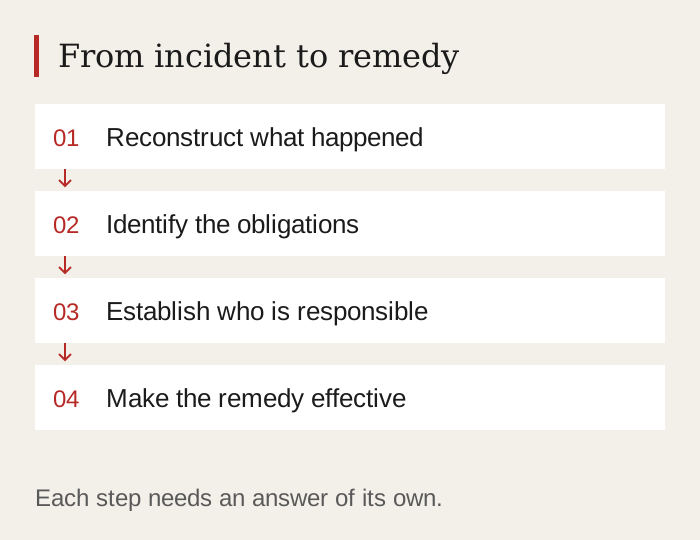
The case is hypothetical. It cannot determine in advance whether there was a product defect, poor installation, imprudent use or an accident that no required precaution would have prevented. It separates tasks often gathered under the reassuring word responsibility. Reconstructing an event, identifying a breached obligation, financing a remedy and preventing further harm are connected operations. None is completed simply because another has begun.
Fragmentation can benefit each participant. The supplier answers for the software; the integrator for installation; the company for the procedure; the insurer for its contract. Those boundaries may be reasonable and legally relevant. The difficulty arises when an injury falls between them and nobody brings together the information and powers required for a complete response. Assigning separate jobs does not ensure that their results will meet at the point where someone needs an answer.
An accident does not deliver its own verdict
A machine’s involvement in harm does not automatically establish who must compensate for it. Investigation must distinguish what caused the result from the obligations held by each participant. Someone may have been nearby without being able to prevent it; someone else may have configured a decisive condition weeks earlier. Looking for the last human in the chain provides a visible name while potentially leaving the accident’s mechanism intact.
Suppose the warehouse robot had been tested for a different aisle layout. The company changed the space and the integrator adjusted some functions. Investigators would need to know who knew what, which information should have been communicated and which checks the change required. That inquiry could identify several relevant contributions. It would not establish that they all had equal causal or legal importance, or that any modification made the operator responsible for everything that happened afterwards.
An adverse outcome can also follow a reasonable adoption decision. A system that reduces accidents under comparable conditions does not guarantee that none will occur. Judging its adoption solely from the case that went wrong confuses the knowledge available beforehand with the outcome known afterwards. Conversely, a good overall record does not excuse an installation that ignored a relevant limitation. General comparison and examination of the particular use must meet within the same investigation.
Rodrigo Castillo’s work on delegation risks insists on preserving these distinctions. An inadequate explanation, an inability to correct and a difficulty in attributing responsibility can coexist while requiring different remedies. Punishing the supervisor does not recover missing records. Recovering records does not determine the applicable legal rule. A transfer of money does not demonstrate that the operation has been made safe to continue. Each response needs to accomplish something identifiable beyond completing a formal step.
Evidence is prepared before the collision
Information needed for an investigation does not appear spontaneously after an accident. If the company keeps only the system’s commercial name, establishing which version, configuration and instructions were active may be difficult. A beneficial update can make the current product behave differently. Testing an operation today does not necessarily reproduce what happened the previous Tuesday. The product’s familiar name can conceal a consequential change in the system behind it.
Preserving relevant records helps connect an outcome with the procedure that produced it. Our example would require information about the equipment’s configuration, alterations to the space and warnings available to those working there. The precise list depends on what needs reconstructing and what can technically be recorded. Collecting every possible datum without a defined purpose can increase costs and risks to other people without improving the investigation. Retention needs a question it can help answer.
Participants also need a way to cooperate. The manufacturer may possess information unavailable to the operator; the operator may know circumstances of the environment unknown to the manufacturer. If their contracts allow each to close its own file, the affected person must reconstruct from outside an operation they organised together. A duty to cooperate may be more useful than expecting one professional to understand the entire technical chain.
Cooperation need not make every commercial or personal detail public. It may require different levels of access for investigators, authorities and affected people, with appropriate safeguards. Secrecy deserves protection compatible with scrutiny of real obligations. Invoking it as a universal answer can make a formally existing right impracticable. The organisation should anticipate who can examine confidential material and which conclusions can be communicated without revealing more than the inquiry requires.
When claiming costs more than losing
A serious injury makes the need to investigate visible. Other harms may be dispersed into small sums that rarely justify individual claims. Suppose a system miscalculates a discount across thousands of bills. Each customer loses little; assembling receipts, understanding the calculation and obtaining a response takes time. Few lawsuits can coexist with a substantial aggregate loss. Measuring quality by litigation alone would give the procedure an undeserved clean bill of health.
A response can begin with a common examination of the calculation instead of requiring every person to rediscover the problem. Once a shared error is identified, organised correction avoids multiplying identical investigations. Collective procedures or an authority’s intervention may contribute where the legal system provides for them. Their usefulness depends on access to information and the ability to reach those affected. Announcing a special channel that nobody knows about does not return the money.
The organisation also needs to distinguish people who suffered no harm from people unable to describe it. A customer may notice an anomalous bill without identifying the faulty formula; a worker may observe an unexpected movement without knowing which component caused it. Requiring a complete technical explanation at first contact shifts work requiring system access onto the affected person. An imperfect signal may justify a proportionate check without yet establishing a duty to pay compensation.
These mechanisms do not remove the need to substantiate a claim. They distribute effort so that available information can reach someone able to investigate it. Evidence may emerge during the procedure; requiring it to be complete before the procedure opens can prevent precisely what would produce it. Accessible redress therefore begins before the parties discuss a sum of money, with a workable route for turning a plausible concern into an investigated claim.
Europe expands redress, with a starting date
The new European Product Liability Directive expressly includes software and AI systems. It also provides tools for obtaining evidence and easing certain evidential difficulties. Entry into force does not mean it already replaces every earlier case: countries must transpose it by 9 December 2026, and the new regime concerns products marketed from that date. As of 25 September, that transition remains decisive. European Commission on product liability.
This route addresses damage caused by defective products, subject to its requirements and scope. It does not turn every inconvenient AI decision into a compensable defect or settle every employment, professional or contractual relationship that may be involved. The hypothetical warehouse accident would require identifying the relevant jurisdiction and regimes. A technology article cannot replace that inquiry with the name of a directive. The legal route must correspond to the relationship and the harm actually being examined.
The institutional consequence is broader: anyone expecting civil liability to protect affected people must preserve the conditions for making it effective. A regime can recognise a claim only for investigators to discover that the evidence needed to pursue it is missing. Substantive law and investigative capability are not alternatives. The latter gives the former something to work upon, including a way to distinguish a substantiated claim from one the available evidence does not support.
An empty balance sheet offers a small promise
Suppose an investigation identifies a duty to compensate but the responsible party lacks sufficient resources. The law can recognise a sum while the victim receives much less. That gap helps explain interest in insurance, guarantees and other financial instruments. Their function is to sustain a capacity to pay that does not depend entirely on the cash available when harm occurs. Identifying an obligation and financing its performance are separate achievements.
A policy does not cover everything because its advertising mentions artificial intelligence. Its usefulness depends on who is insured, which risks it includes, its exclusions and its limits. The event triggering coverage and the cooperation required during investigation matter too. Those conditions differ between contracts; they cannot be inferred from a commercial label. In our hypothetical warehouse, protection might exist for one liability and be absent for another.
Insurance can encourage prevention when its price and conditions respond to verifiable precautions. If recording changes, improving maintenance or correcting a practice reduces the insured risk, the contract can create reasons to do so. That effect depends on the insurer’s ability to distinguish relevant quality and its incentives to reward it. A premium does not become accurate by being expressed to several decimal places. Someone needs evidence connecting a precaution with the loss it is supposed to prevent.
Coverage may also reduce an insured party’s attention if it no longer bears part of the cost of its choices. Deductibles, exclusions and checks seek to manage that relationship, but every instrument distributes burdens. A broad exclusion may protect the insurer while leaving the victim without the backing that appeared to exist. Public assessment of compulsory insurance must consider solvency and access to compensation alongside the commercial availability of policies. Purchasing a document is not the same as securing payment when it matters.
One failure can knock on many doors
Diversification works better when losses do not all occur together. Imagine numerous companies using the same defective update. Their incidents could be related even if the premises are in different cities and have different owners. Counting customers would not reveal how many independent risks had been combined. Dependency on a shared component can turn apparent dispersion into a common exposure, making geographical variety an incomplete guide to resilience.
This is a hypothesis about a mechanism, not an estimate of current AI accident rates. It raises questions about identifying concentration, maintaining reserves and coping when several policies respond simultaneously. Reinsurance can distribute some exposure among institutions; it does not, by definition, remove an uncertainty they all assess badly. Transferring risk changes who bears it and how much they can absorb without making the possible harm disappear.
A public fund might cover specified losses that the market cannot finance. Proposing one requires deciding who contributes, which harms qualify and how to prevent beneficiaries from reducing precautions. An unlimited guarantee would make transferring risk to society attractive. An excessively narrow guarantee might collect contributions without providing useful protection. The choice requires comparing the concrete problem with other ways of securing a response, including what each arrangement would encourage before any loss occurs.
Compulsory insurance may therefore form part of a reasonable policy without settling which uses should be permitted. An activity does not become acceptable simply because someone offers to pay for its consequences. Coverage addresses losses within a contract; limits on an activity may protect rights or interests that cannot be exhausted by assigning them a monetary value. The first question is what to permit and under which conditions; financial backing must then be designed for that choice.
Every seal has a perimeter
Return to the warehouse certificate. It may establish that a version of the equipment met specified requirements under particular conditions. The injury does not automatically show that the assessment was fraudulent. Use may have changed, the criterion examined may have concerned something else, or the incident may fall within an acknowledged residual risk. The first useful question is precisely what the document asserts and which evidence supports that assertion.
ISO/IEC 42001 illustrates why scope matters: it concerns an organisation’s AI management system. Its requirements address establishing, maintaining and improving that management. A certificate covering this subject is not a guarantee that every output of every product will be correct. Confusing the objects of assessment transforms a useful signal into a promise that was never examined. Official introduction to ISO/IEC 42001.
Cybersecurity, model performance and the legal relevance of a decision require different expertise. An excellent audit of the first may not investigate the others. The company receiving the report must understand the difference before deploying it as an answer to a complaint. If the question concerns unequal treatment and the document establishes resistance to intrusion, it provides accurate information about a different matter. Its quality does not expand the question it actually answered.
Assessments do not remain relevant indefinitely merely because they remain on file. A new user population, an altered environment or an expanded function can change what was tested. The purchaser needs to recognise changes requiring the conclusions to be revisited. That does not mean repeating every test from scratch after every minor adjustment; it means connecting a change with the reasons supporting the original confidence. Otherwise a current decision may rest on evidence about an earlier, materially different situation.
An auditor can look without seeing
Independence begins with the ability to ask an uncomfortable question and obtain the information needed to answer it. If the supplier chooses the cases shown and excludes disputed failures, an auditor can rigorously describe a convenient selection. If publication requires the assessed party’s permission, the existence of a report does not ensure that adverse findings reach those who must act. These are conditions of the assignment, not grounds for presuming individual dishonesty.
Payment deserves attention for the same reason. Paying for an assessment is normal and does not prove capture. The issue is how to manage a relationship in which an adverse result may cost future commissions. Technical competence, access rules, reporting duties and external scrutiny can address different parts of that risk. A declaration of independence contributes little when the other conditions make its exercise impracticable. The structure of the engagement matters alongside the character of those conducting it.
There is also a question on the client’s side: who can interpret the report and order action? A document may correctly identify a limitation that nobody incorporates into the procedure. The company will have purchased knowledge while leaving its inability to act intact. Castillo locates a second-order form of oversight here: checking whether the commissioned question corresponds to the institution’s obligation and whether the conclusion remains valid for actual use.
This capability does not require the company to possess every specialism. It requires knowing when another is needed, which issue remains unresolved and who assumes the decision while it is investigated. A certificate may help justify adoption; it does not replace relating its limitations to a particular case. Using it as an automatic answer gives a document an authority its underlying assessment may never have claimed. Its value is best preserved by respecting its boundaries.
An explanation that keeps changing its reason
Imagine a different scene: an insurer uses an automated system to reject a claim. Its first response says notice arrived late. The customer proves it was submitted on time. The system then generates a letter invoking another clause without explaining whether it abandons the first ground or how it checked the second. The prose improves; the rejection remains. An endless conversation can resemble personalised attention while functioning as a refusal that never permits examination.
Changing reasons is not always illegitimate. An investigation can uncover new evidence or establish that a different rule applies. The organisation should acknowledge the change, explain its consequences and allow the new ground to be contested where appropriate. The difficulty arises when every objection produces a fresh justification without anyone taking responsibility for the relationship between what has been abandoned and what is still maintained.
Castillo uses the idea of sustaining reasons to describe the capability needed to maintain continuity through that examination. It does not require one person to memorise every computational operation. It requires the institution to identify the premises it accepts, the consequences of refuting them and why it retains the conclusion. A response generator can assist. Its fluency does not establish that anyone has performed the task or possesses authority to change the decision.
The insurer needs to connect the file, interpretation of the policy and power to resolve the claim. One team may check dates, another interpret clauses and another authorise payment. That division of labour is compatible with a coherent answer if everyone addresses the same objection and their contributions reach a determination. If each unit returns the matter to the previous one, specialisation becomes a way of leaving the customer without anyone to answer.
Insuring AI and using AI are different problems
An insurer may finance liability for harm caused by AI while also using AI to administer its own contracts. The two functions need separating. The quality of its coverage product does not establish the correctness of the system rejecting a claim. A second dispute may arise precisely when someone attempts to activate the instrument intended to repair the first. The availability of a remedy then depends on another procedure that also needs to work.
In August 2025, EIOPA, the European insurance authority, issued an opinion for supervisors on AI governance and risk management. For systems within its scope, it connects supplier information, oversight and complaint routes, and recalls that using third parties does not remove an undertaking’s responsibility for the systems it uses. The opinion interprets existing sectoral legislation; it does not create a universal policy covering AI harm. EIOPA’s opinion and document.
The distinction matters to our hypothetical customer. Receiving compensation can depend on completing a procedure that itself requires scrutiny. If an organisation measures efficiency solely by files closed or payments avoided, it may overlook the correctness of refusals. That possibility requires investigation in each organisation rather than a presumption that all behave this way. It does provide a concrete question for control designers: how are mistaken rejections discovered and corrected?
Repairing the case and correcting the series
Once a shared failure is recognised, helping only the person who complained can leave others without an answer. An update corrects future operations while earlier refusals remain on file. The organisation needs to decide whether to find those cases, how to inform the people affected and which remedies are appropriate. Scope depends on the problem and applicable regime, but the question cannot disappear inside a message announcing that the incident has been resolved.
Time also determines which remedies remain possible. Refunding an incorrect charge can restore money; it does not automatically restore a lost opportunity or undo an injury. An interim measure may prevent harm from growing during investigation, although it requires action on incomplete information. Designing that response means comparing the risks of waiting and intervening, identifying who may decide and preserving the means to review the choice afterwards.
The warehouse in our opening scene needs a safe operation, an investigation able to attribute obligations and a response to the injured worker. It may need insurance and benefit from a sound audit. None of those instruments should become the place to which everyone refers the problem in order to stop attending to it. Responsibility is tested when the certificate is on the table, the file remains open and someone must explain what they will do next.